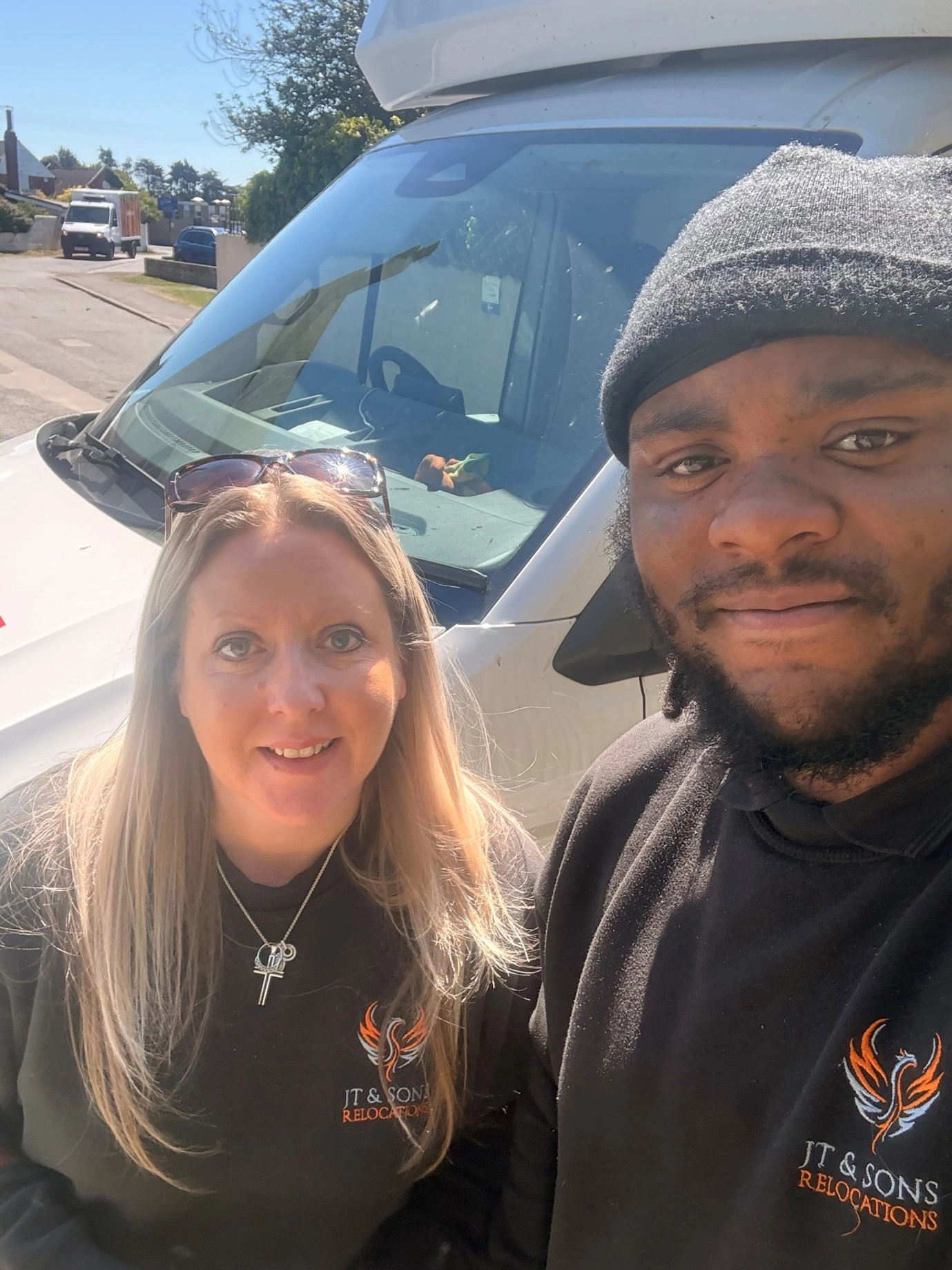
We are incredibly proud to have contributed to the August edition of Health Estate Journal, exploring why relocation should be treated as an integral part of healthcare transformation rather than simply a logistical exercise.
Drawing on JTS Relocations’ extensive experience within live clinical environments, the article looks at how early planning, close collaboration and careful management of people, equipment and assets can minimise disruption, support clinical teams and protect continuity of patient care. It also considers the important role relocation can play in sustainability, social value and the successful delivery of wider estates programmes.
Healthcare relocations bring with them a host of challenges. Here, Jenny Thorncroft, director, JTS Relocations, looks at how, when managing relocations within live healthcare environments, communication and partnership between estates teams and other stakeholders can minimise disruption, support staff wellbeing, and ultimately help protect patient experience and continuity of care during periods of organisational change.
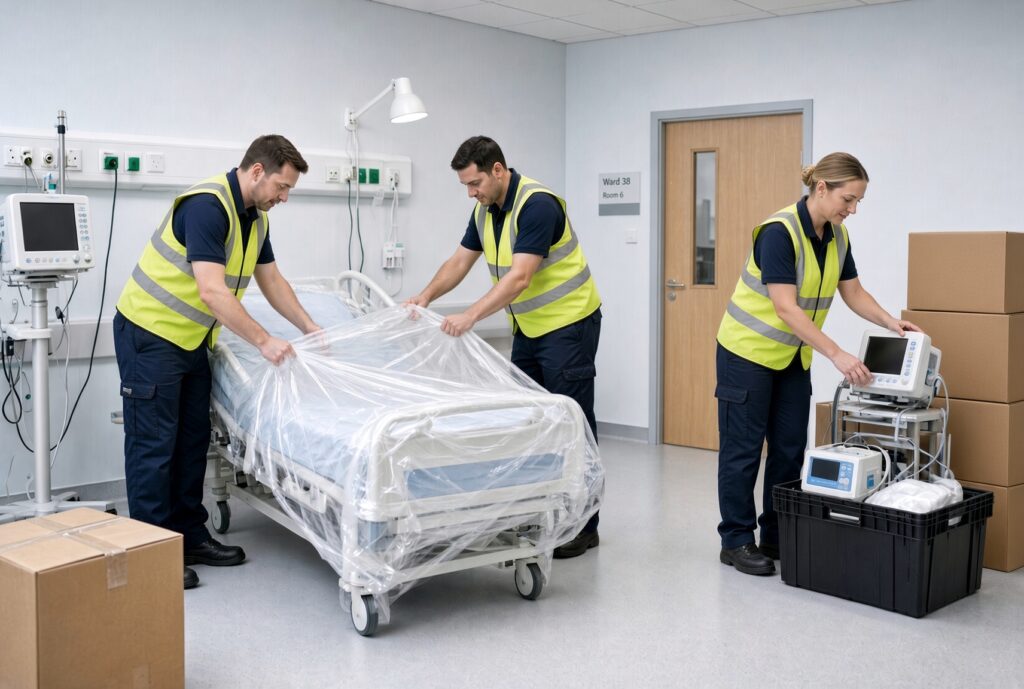
Across the NHS, estates are being reshaped at pace. Major capital programmes, new hospital developments, backlog-driven refurbishments, and service reconfigurations are all driving significant change across the estate. Much of the focus naturally sits on construction, engineering, and commissioning, but one of the most operationally critical phases of these programmes is often underestimated: the physical transition of services, equipment, and departments within live clinical environments. When not properly planned and integrated, this phase can introduce significant risk, from service disruption and asset loss through to increased pressure on already stretched clinical teams. In practice, it is often the point at which otherwise well-planned projects encounter avoidable operational challenges.
Unlike construction activity, which can often be separated from day-to-day operations, relocation activity takes place directly within the live clinical environment. Wards remain operational, theatres continue to run, and critical services must be maintained throughout. This creates a fundamentally different risk profile. Relocation is therefore not simply a logistical exercise. It sits at the interface between construction, commissioning, and clinical operations, requiring detailed planning, careful sequencing, and close coordination with estates and clinical teams to ensure continuity of care is maintained at all times. In complex programmes, this rarely involves a single move. More often, it forms part of a phased decant strategy, with multiple transitions taking place over extended periods, aligned to construction milestones and operational constraints. When managed well, these transitions are barely visible. When managed poorly, the impacts can be immediate and highly visible. Asset and equipment management.
Asset and equipment management
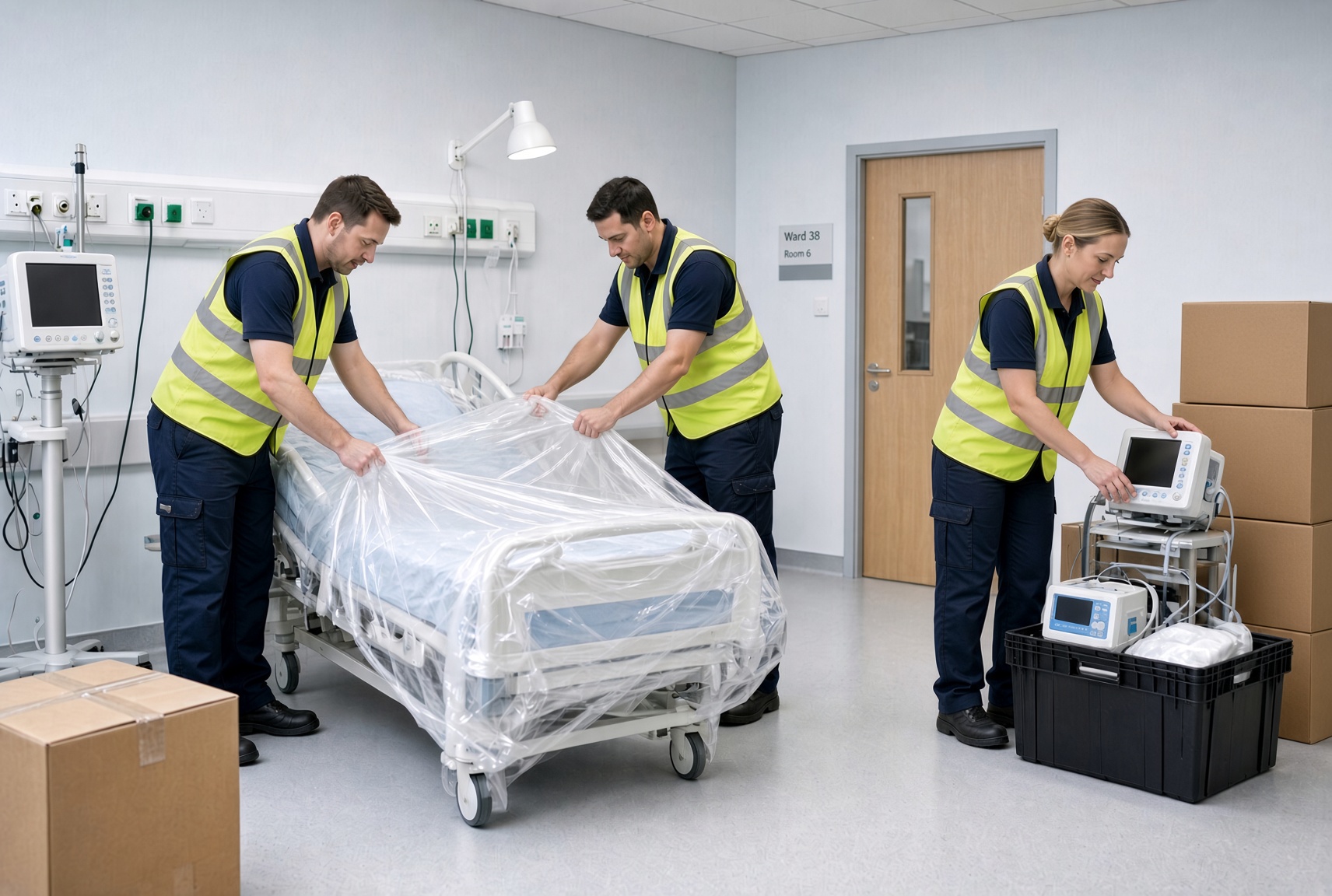
One of the most common areas of risk sits around the management of equipment and assets during transition. Healthcare relocations frequently involve the movement of highly specialised, high-value, and often sensitive equipment, from diagnostic devices and laboratory contents through to temperature-critical materials. Without structured planning and appropriate controls, equipment can often end up temporarily stored in unsuitable locations such as service corridors, ad hoc rooms, or unmanaged spaces, increasing the risk of damage, loss, or non-compliance with infection control protocols. These issues are rarely the result of poor intent but rather a lack of integration between operational planning and physical transition activity. There is a clear opportunity to address this more systematically by integrating relocation planning with existing estates data and asset management systems. Linking asset tracking during moves into CAFM platforms and wider estate management systems can provide real-time visibility of equipment location, status, and condition throughout the transition process, particularly when aligned with operational dashboards and estate intelligence tools. In this context, relocation becomes not just a physical activity but part of a broader, data-informed approach to managing clinical environments efficiently and safely.
Alongside asset management, maintaining clinical continuity remains the defining requirement. Moves must be carefully sequenced around clinical activity, often requiring out-of-hours working and flexible delivery approaches that can respond to changing operational pressures. This demands close collaboration with clinical teams to understand dependencies, critical services, and operational constraints, ensuring that relocation activity supports rather than disrupts patient care. Despite this, relocation is still frequently treated as a late-stage consideration. In reality, early integration into programme planning is essential. Aligning transition activity with construction and commissioning programmes allows estates teams to anticipate constraints, plan temporary arrangements, and reduce the risk of delays or disruption later in the process.
A parallel workstream
A further challenge sits in how relocation activity is typically procured within major programmes. It is often treated as a subcontracted logistical service, brought in late, and driven primarily on cost. In practice, this can lead to a limited understanding of the operational and clinical sensitivities involved, with relocation activity managed as a discrete task rather than an integral part of programme delivery. Given that relocation sits directly within live clinical environments, often in close proximity to patients and frontline staff, this approach can introduce avoidable operational and clinical risk. It can also create barriers to implementing more integrated approaches, such as linking asset tracking into CAFM systems or wider estate management platforms, where early planning, data alignment, and stakeholder coordination are essential. There is a strong case for treating relocation as a parallel workstream, aligned to soft landings principles and working collaboratively with estates, clinicians, and contractors. When approached in this way, relocation becomes an enabling function, supporting smooth transition, improving asset visibility, and reducing pressure on clinical teams while contributing to overall programme performance.
Relocation programmes also present a practical opportunity to support wider sustainability objectives. A reuse first approach, prioritising the redistribution of furniture and equipment within estates or through donation and resale, can significantly reduce waste and support circular economy principles. Where reuse is not viable, responsible recycling routes can further minimise environmental impact. Capturing the carbon impact of relocation activity also provides greater visibility of emissions associated with transition phases, supporting wider sustainability reporting and more informed decision making over time. There is also increasing recognition of the role relocation can play in delivering social value. By aligning operational activity with community needs through the redistribution of surplus equipment, for example – estates programmes can extend their impact beyond the hospital estate in a tangible and meaningful way.
Ultimately, successful delivery comes down to people as much as process. Relocation teams are often working alongside clinical staff and, in some cases, in close proximity to patients. This requires a calm, professional, and respectful approach, underpinned by clear communication and an understanding of the clinical environment. As NHS estates continue to evolve, the ability to safely and efficiently transition services will become
increasingly important. The success of major programmes will depend not only on what is built but on how effectively services are moved and reestablished within new or reconfigured environments. In that context, relocation should not be seen as a secondary logistical task but as a
core component of programme delivery, one that, when properly planned and integrated, can reduce risk, support clinical teams, and contribute to the overall success of healthcare transformation.
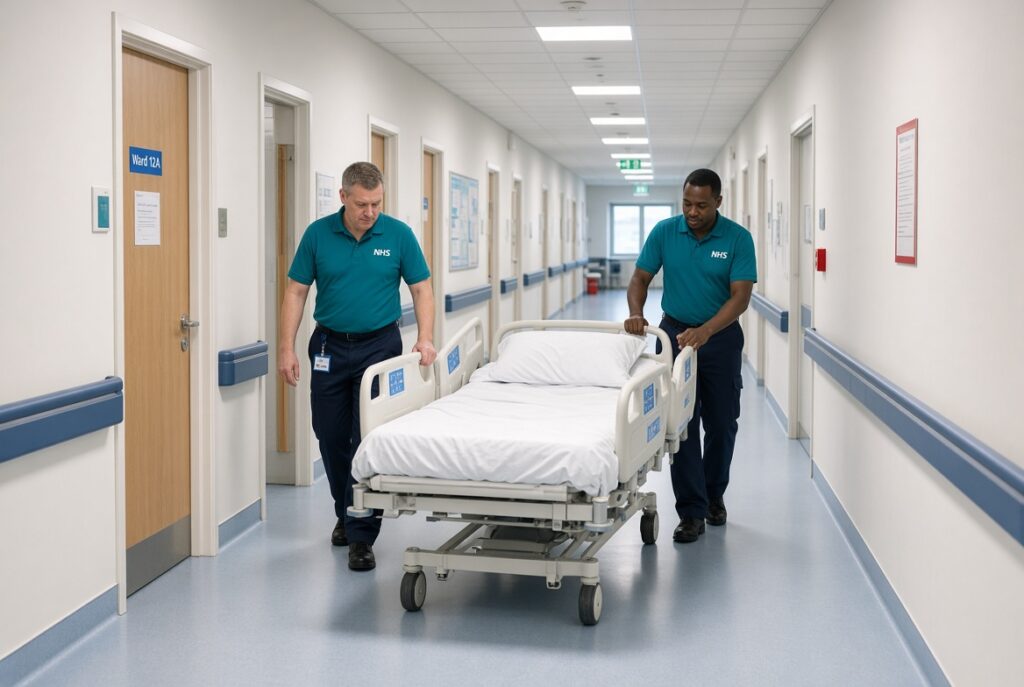
Case study: a live paediatric hospital environment
The risks associated with poorly integrated transition activity are perhaps most visible in large, specialist hospital environments, where the complexity of services and the sensitivity of patient cohorts combine to create a particularly demanding operational context. This can be seen in the delivery of a series of relocation and decant programmes within a major London children’s hospital, undertaken over a number of years to support
refurbishment works, new building integration, and ongoing service reconfiguration.
In this instance, relocation did not take the form of a single, discrete move, but rather a sequence of interdependent transitions aligned to construction milestones and changing operational requirements. Clinical departments, ward areas, theatres, and a wide range of equipment and specialist items were moved over time, often within tightly defined windows and, on occasion, at short notice. As is often the case in healthcare
settings, the complexity lay less in the physical movement itself and more in how that activity was integrated into a live, continuously operating clinical environment.
Maintaining clinical continuity
Early engagement with estates teams, clinical staff and departmental leads proved critical in shaping how the programme was approached. Rather than applying a fixed logistical plan, relocation activity was structured around clinical priorities and operational constraints, allowing moves to be sequenced in a way that supported the continued delivery of care. Much of the work was therefore undertaken outside standard hours, where this reduced impact on patients, visitors and frontline teams. Even with this planning in place, flexibility remained essential, with the programme adapting in response to changing clinical demands and the realities of working within a live environment.
The nature of a paediatric hospital also introduced additional considerations, not only in terms of infection control and operational sensitivity, but in the way that
relocation teams needed to work within spaces that were, at all times, patient-facing. Careful route planning, combined with clear communication and consistent on-site briefings, helped ensure that all personnel understood both the physical constraints of the environment and the behaviours expected of them. In this context, delivery becomes as much about how work is carried out as it is about what is being moved.
Maintaining clinical continuity
Early engagement with estates teams, clinical staff and departmental leads proved critical in shaping how the programme was approached. Rather than applying a fixed logistical plan, relocation activity was structured around clinical priorities and operational constraints, allowing moves to be sequenced in a way that supported the continued delivery of care. Much of the work was therefore undertaken outside standard hours, where this reduced impact on patients, visitors and frontline teams. Even with this planning in place, flexibility remained essential, with the programme adapting in response to changing clinical demands and the realities of working within a live environment.
The nature of a paediatric hospital also introduced additional considerations, not only in terms of infection control and operational sensitivity, but in the way that relocation teams needed to work within spaces that were, at all times, patient-facing. Careful route planning, combined with clear communication and consistent on-site briefings, helped ensure that all personnel understood both the physical constraints of the environment and the behaviours expected of them. In this context, delivery becomes as much about how work is carried out as it is about what is being moved.
Maintaining clinical continuity remained the defining requirement throughout. Certain transitions were required to take place within tightly controlled windows to allow services to be re-established with minimal downtime, requiring close coordination between relocation teams and operational staff. This included the sequenced movement of equipment, the rapid reinstatement of clinical areas, and the ability to respond in real time where priorities shifted. The importance of this adaptability should not be underestimated, particularly where relocation activity sits directly alongside ongoing patient care.
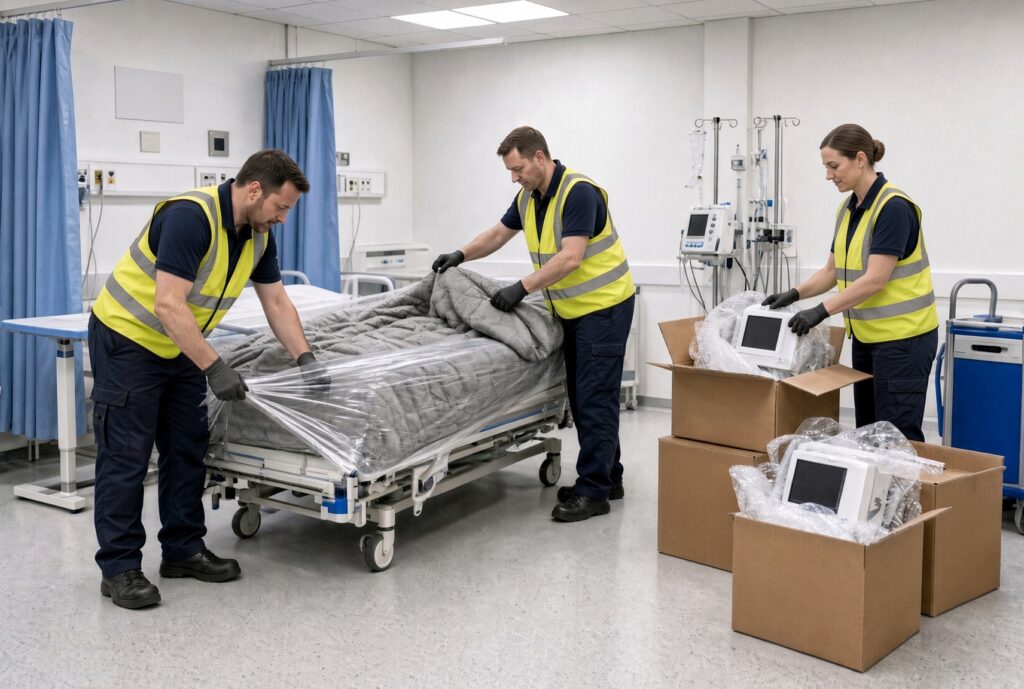
As with many programmes of this nature, the management of equipment and assets formed a significant part of the overall risk profile. The relocation of high-value and often sensitive items, including medical equipment, laboratory materials, and IT systems, required structured processes to maintain visibility and ensure safe handling throughout. Labelling, inventory control, and appropriate packing were all used to support this, alongside specialist handling techniques and, where necessary, coordination with equipment manufacturers. While these measures are often seen as standard practice, their consistent application within a live environment is what ultimately underpins reliability.
An integrated workstream
What becomes clear through programmes such as this is the extent to which successful transition relies on effective coordination across a wide range of stakeholders. Engagement was maintained throughout with senior leadership, clinical teams, and operational staff, allowing programme activity to be clearly communicated and issues addressed as they arose. This collaborative approach is often less visible than the physical move itself, but is
fundamental to ensuring that relocation activity supports, rather than disrupts, the delivery of services.
The programme was delivered across multiple phases without disruption to patient care, but more importantly it illustrates a broader point. Where relocation is treated as an integrated workstream, aligned with estates planning, clinical operations, and programme delivery, it becomes possible to manage transition in a way that is both controlled and largely unseen. Conversely, where it remains a late stage or isolated activity, the risks outlined earlier in this article are far more likely to materialise.In that sense, this example reinforces a consistent theme: the success of mhealthcare transformation programmes depends not only on what is built, but on how effectively services are transitioned into new or reconfigured
environments. It is within that transition phase that many of the operational risks sit, but also where, with the right approach, they can be most effectively managed.